|
|
IMK Research
|
|
| what is new? | ||||||||||
![]() ![]() ![]() ![]() ![]() ![]() ![]() ![]() ![]() |
|
|||||||||
Particle Habit Imaging and Polar Scattering
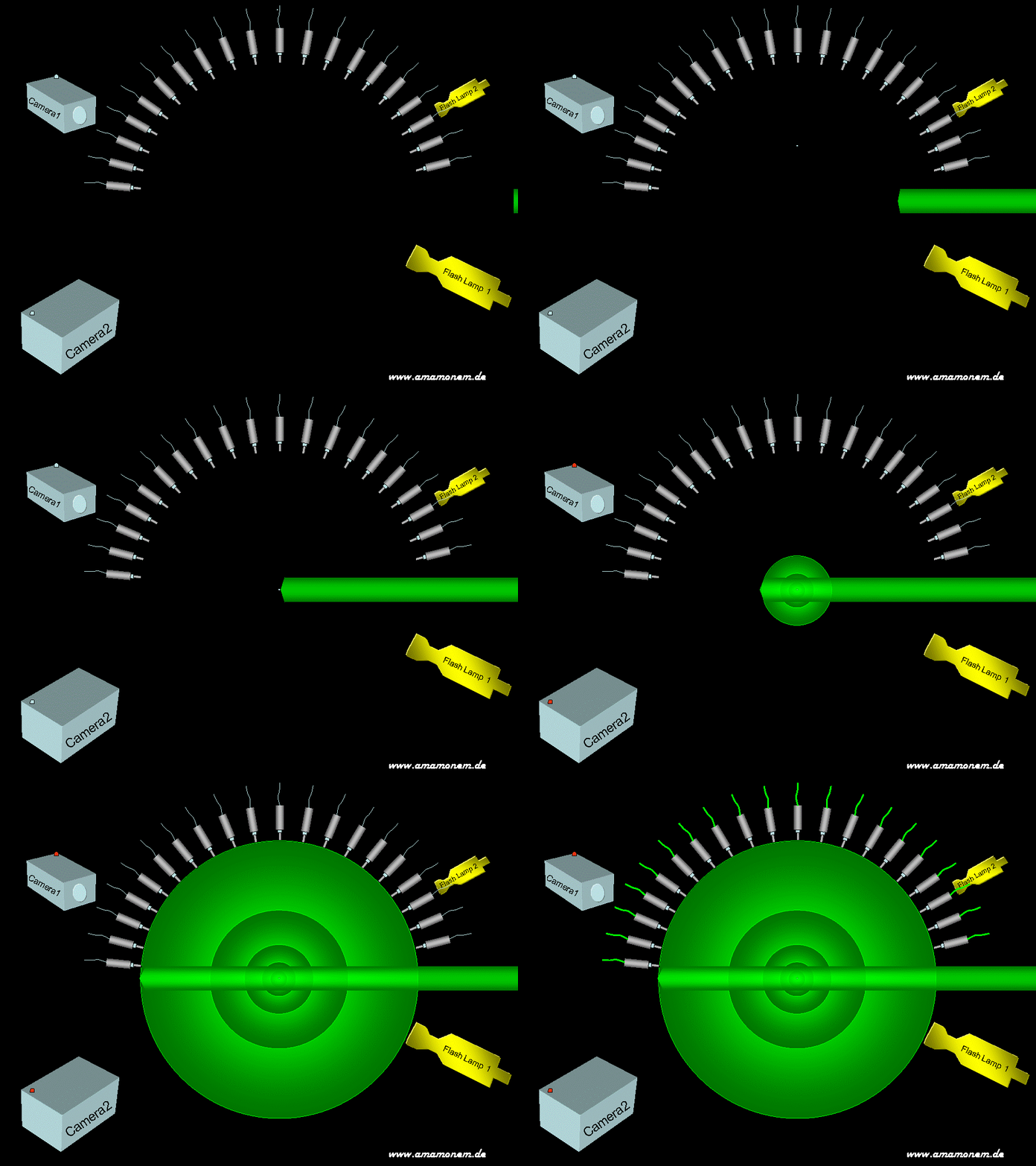
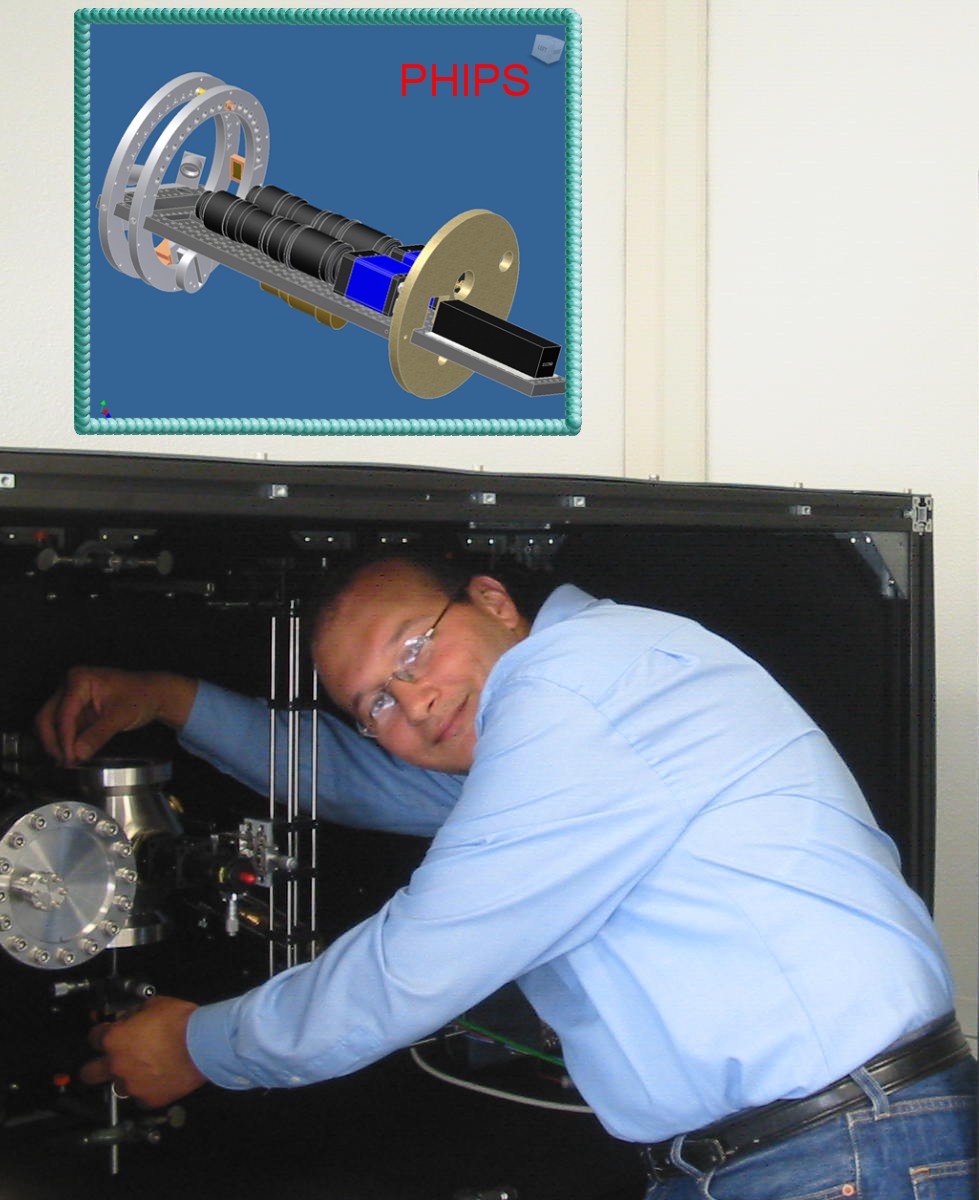
PHIPS is a new experimental device for imaging individual ice crystals and measuring simultaneously the scattering phase function of the corresponding crystals. Compared to existing imaging and scattering devices, PHIPS is planned to record both imaging and scattering correlated information for a specific particle. Thereof an automated detection process based on an on-spot event-triggered-system technique is used in PHIPS. Efforts were done on the imaging part of PHIPS to improve the resolution power down to few microns and to facilitate the 3D morphology of the ice crystals. The scattering part of PHIPS enables the measurement of polar scattered laser light and hence the scattering phase function of ice crystals and water droplets with an angular resolution of 1° for forward scattering (from 1° to 10°) and 8° for the rest of a half circle (from 18° to 170°). PHIPS is the first step to PHIPS-HALO which is one of the in situ ice particle and water vapor instruments that are currently under development for the new German research aircraft HALO (planed to be operational in 2009). Next>
Start: 01/06/2008
The actual start was some when in Apr/2008 as a type of cooperation in putting the primary design for the aircraft-PHIPS version.
Missions:
Together with M. Schnaiter
|
|
Development of a new experimental device for imaging individual ice crystals and measuring simultaneously the scattering phase function of the same crystal (Particle Habit Imaging and Polar Scattering Probe, PHIPS). The scattering part of the device will measure the scattering phase function at 532 nm and with an angular resolution of about 8 degree. Since large ice crystals tend to scatter in near-forward direction efforts are made to enhance the angular resolution in this region |
|
|
The plan is to produce two version if the PHIPS; |
| 1. |
A Laboratory version to detect ice particles generated in the AIDA and travels through the Lab-PHIPS with a velocity of ~2m/s. |
| 2. | Image and scattering data analysis |
| 3. | An aircraft (HALO) version to detect the ice particles at high altitudes travels through the HALO-PHIPS with a velocity of ~200m/s |
Progress:
|
Jul/2008 |
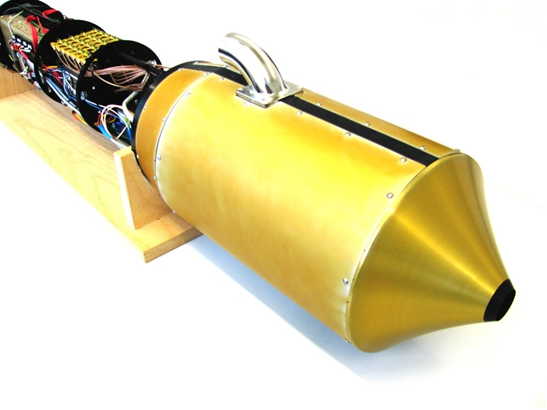
A CAD version of the HALO-PHIPS is finished. Some components were ordered or constructed. The optical part is a complete mobile stereo imaging and polar scattering Lab of dimensions of a relatively big watermelon.
|
||||
|
Sep/2008 |
|
||||
| Nov/2008 |
|
||||
|
21/Nov/2008 |
Laboratory version of PHIPS Scattering phase function with stereo imaging
for Glass beads (40µm diameter) was obtained as a simulation to the real experiment on ice particles
|
||||
|
Dec/2008 AIDA campaign HALO02 |
First real experiment for the new Laboratory version of PHIPS The instrument was tested in the ice cloud characterization campaign HALO-02 which was deduced in December 2008 at AIDA in the temperature range from -5°C to -70°C. The effects of atmospheric aging processes on the aerosol optical properties are investigated by simulation experiments using the aerosol chamber facility AIDA. The instrument showed a reliable operation during the campaign with a relatively fast data acquisition rate up to 2 Records/sec which can be increased optionally. Resolved particle size in the imaging part was about 7µm and larger (up to 800µm is possible). Resolved particle size in the scattering part was around 2µm and larger. Scattering information is collected as an Integrated- and/or Time Domain- counts/particle/channel which opens a new category of data analysis rich of information, e.g. about time evolution of the scattering event and particle speed. Time Domain acquisition has a time resolution of 1count/400ns. Finally, thank to the stereo imaging, debates in particle morphology were terminated, e.g. whether a particle is a column or sphere if a column was viewed unluckily with its base plane oriented perpendicularly to the optical axis of a single camera. AIDA campaign HALO02
Results:
|
||||
|
May/2009 Image Analysis |
A complete image analysis software package is written using Labview to carry out the particle image analysis for PHIPS results. The data sets from the PHIPS imaging part are now uploaded to the AIDA server. More details are explained on the Wiki.
|
||||
| Jun/2010 |
A complete Polar Scattering analysis software package is written using Labview to evaluate the scattering phase functions of the particles detected by the PHIPS. However, the next step is to calibrate the scattering geometry to get exact phase functions. |
||||
|
Later than
Jun/2010 |
|